← Home
Forward Health Dashboard
Designing Forward's final product bet: a full-body diagnostic scan.
BTW, this is an overview. If you’d like to learn more or view the case study, please reach out.

The search for PMF
By the end of 2024, Forward was searching for product-market fit. The company had built some strong technology: self-operating clinics, integrated health hardware, and a mobile care platform. But, it hadn't yet found the product that tied it together. The Full Body Diagnostic was that bet.
Members would walk into our self-serve clinics, run a comprehensive screening and receive a complete picture of their health in the Forward app within two weeks. It was preventive care, productized.

So how do we bridge data and action?
A diagnostic is only as useful as what comes after it. Raw lab results like hormones, electrolytes, and metabolic markers mean very little to most people without context. The dashboard needed to close that gap: translate clinical data into something a person could actually act on.

Data: What results came back from the scan?

Insights: What does this information mean for their health?

Next Steps: What could they do about it?
The loop: scan, understand, act
The first instinct was to separate data, insights, and next steps into distinct sections. This was logical on paper, but broken in practice. Users had to scroll through disconnected pieces before anything clicked. It increased cognitive load without adding clarity.
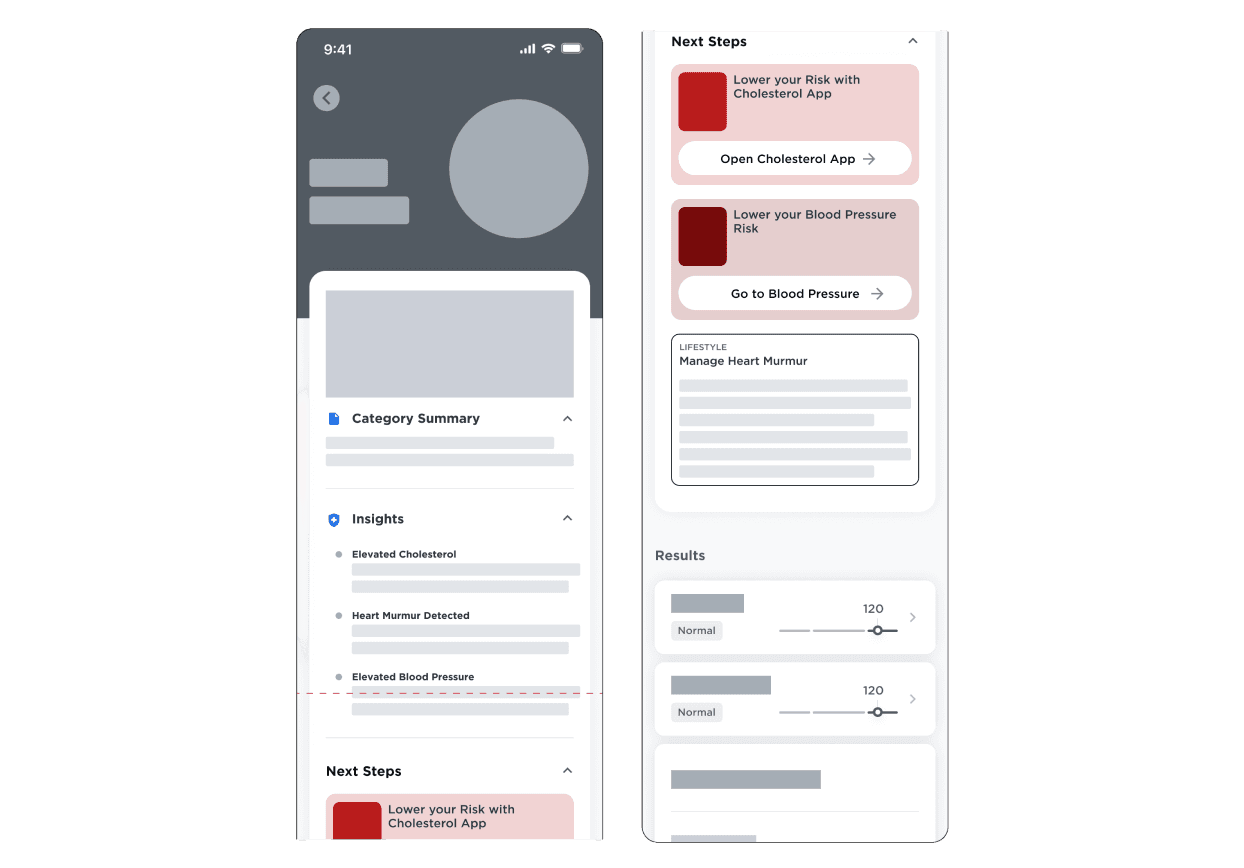
Through testing, we gained an insight that unlocked our next iteration: the mapping is the product.
Rather than presenting information and leaving users to draw conclusions, we built focus cards. These were clinician-driven groupings that paired biomarker data with a diagnosis and a clear next step, all in one place.

From there, the dashboard routed users to Forward's Health Apps to provide personalized plans for cholesterol, hormones, metabolic health issues. Where an app didn't yet exist, we provided doctor-written guidance. The experience completed a full loop: scan, understand, act.

What happened next?
Abruptly, Forward shut down a few months later. Turns out, running self-operating clinics with a personalized health platform takes serious capital and infrastructure.
A few months later, companies like Ezra and Superpower showed up doing something close to the same thing. Turns out the demand was there all along, but the market just needed time to catch up to the product Forward was already building.
I'm still quite optimistic on where healthcare is going. The existing model of healthcare that relies on reactive, episodic care is failing us. Forward didn't make it, but the question it was asking is still worth asking… and the companies now answering it are proof that it was always the right one :)
